www.stairporn.org
Stairs and nothing else...
Our personal favorite:
http://materialicious.typepad.com/.shared/image.html?/photos/uncategorized/2008/11/03/thegrayhotel.jpg
Tuesday, November 18, 2008


Sunday, October 12, 2008
Our new project is taking form, and it is exciting to watch it grow.
The project was to take ideas and strategies from our previous studies and use those to design a masonry wall. We are taking the ideas of "danger zones" and involving them in our studies. Looking at light specifically, we studied light and shadow on the site. Considering these two options, light and dark, as environmental "extremes" or "dangers", one study of our project is creating a wall that allows light to get through, and to shut light out.
Interestingly, it is not only the wall that facilitates this passage of light and creation of dark, but the structures themselves. With a module form, our brick walls and larger-scale modules take on the same form on a basic level. Just as the brick forms the wall, the module forms the structure. In our project however, the brick forms the wall that forms the modules that form the structure. Using standardized geometries to create unique programmatic arrangements is another challenge.
How do we decide the arrangement of the walls? Of the modules?
Looking at the site itself, identifying the danger zones, we can look at what potential each DZ has progamatically. Darker areas may be good for rest, for growing crops that don't require much sunlight, for monastery cloisters, etc. Lighter areas are better for solar panels, plant life, and everyday living. Perhaps a majority of passages could be exposed to natural light while the darker areas in our module wall could house the biotech labs/monastery cells? Perhaps the eco-resort is in both danger zones - half light and half dark.
The project was to take ideas and strategies from our previous studies and use those to design a masonry wall. We are taking the ideas of "danger zones" and involving them in our studies. Looking at light specifically, we studied light and shadow on the site. Considering these two options, light and dark, as environmental "extremes" or "dangers", one study of our project is creating a wall that allows light to get through, and to shut light out.
Interestingly, it is not only the wall that facilitates this passage of light and creation of dark, but the structures themselves. With a module form, our brick walls and larger-scale modules take on the same form on a basic level. Just as the brick forms the wall, the module forms the structure. In our project however, the brick forms the wall that forms the modules that form the structure. Using standardized geometries to create unique programmatic arrangements is another challenge.
How do we decide the arrangement of the walls? Of the modules?
Looking at the site itself, identifying the danger zones, we can look at what potential each DZ has progamatically. Darker areas may be good for rest, for growing crops that don't require much sunlight, for monastery cloisters, etc. Lighter areas are better for solar panels, plant life, and everyday living. Perhaps a majority of passages could be exposed to natural light while the darker areas in our module wall could house the biotech labs/monastery cells? Perhaps the eco-resort is in both danger zones - half light and half dark.
Monday, October 6, 2008
Green


Here is a link I found about a plant facade. This may be something we try to incorporate into our wall/building.
http://continuingeducation.construction.com/article.php?L=5&C=440
Wednesday, October 1, 2008
New Direction - Puttin' Up a Wall
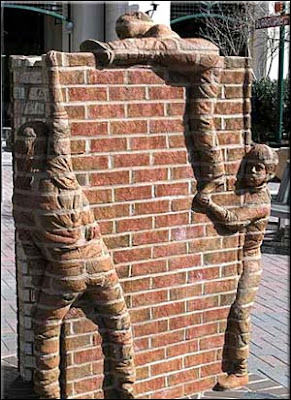
We have a new goal, and it is to construct a wall. This post is to upload images of walls I've found on the internet.
They all do something that is beyond the original intent and scope of a brick wall. They may have the inherent function, but they may also have additional functions - be they "functional" in of themselves or "artistic".
The second project shown is one found in Quebec, Canada. It was an effort to create a "green" architecture, even back in 1967. It was great in the summer - cooling breezes to keep temperature costs down. In the winter, however, it's another story. The exposed balconies and terraces gave way to heating issues, causing the costs of heating to go way higher than what was sensible for the green label.
A case of "great concept, wrong climate".

Friday, September 26, 2008
Progress...
Lately, our project has focusing on what is going to be happening 100 years from now. It has been both fun and a little scary speculating exactly what 100 years from now will be like. We have been working with two different quotes that we found. The "today" quote is:
http://www.france24.com/en/20080607-no-oil-crisis-says-us-energy-secretary-samuel-bodman
This quote is one of the scariest things that we have come across because it proves that there are still people (even US secretaries!) that believe that we can continue our way of life without any consequences.
Our quote for the future is:
"My grandfather rode a camel, my father rode a camel, I drive a Mercedes, my son drives a Land Rover, his son will drive a Land Rover, but his son will ride a camel." from Sheikh Maktoum bin Rashid Al Maktoum, who is responsible for the transformation of modern Dubai.
Thus far we have speculated that due to the rising fuel prices, the ferry, which is the main mode of transportation between Kelley's Island and the mainland, will slow it's frequency of operation until it only runs once a week or a couple times a month. This will force the people who want to stay on the island to provide for themselves and those that do not want to become farmers will have to move to the mainland. Therefore, the farmland will begin to take over the abandoned areas of the island and the people that stay will have to work together in order to have enough food and supplies to survive.
"No oil crisis, says US energy secretary
Saturday 07 June 2008
The US energy secretary, Samuel Bodman, said Saturday there was no oil crisis despite a sharp rise in crude prices overnight and that he did not see a need to tighten regulation of the market. (Report: O. Fairclough)"
from:http://www.france24.com/en/20080607-no-oil-crisis-says-us-energy-secretary-samuel-bodman
This quote is one of the scariest things that we have come across because it proves that there are still people (even US secretaries!) that believe that we can continue our way of life without any consequences.
Our quote for the future is:
"My grandfather rode a camel, my father rode a camel, I drive a Mercedes, my son drives a Land Rover, his son will drive a Land Rover, but his son will ride a camel." from Sheikh Maktoum bin Rashid Al Maktoum, who is responsible for the transformation of modern Dubai.
Thus far we have speculated that due to the rising fuel prices, the ferry, which is the main mode
 of transportation between Kelley's Island and the mainland, will slow it's frequency of operation until it only runs once a week or a couple times a month. This will force the people who want to stay on the island to provide for themselves and those that do not want to become farmers will have to move to the mainland. Therefore, the farmland will begin to take over the abandoned areas of the island and the people that stay will have to work together in order to have enough food and supplies to survive.
Tuesday, September 23, 2008
Reading Response: The Third Landscape
Article given to us by Karl.
In the Third Landscape, Gilles Clément is being interviewed by Denise Bratton. In the interview the two discuss the concept of the "third landscape", or tertiary space that is, for all intents and purposes, abandoned. This abandoned space is more or less left to itself (with the occasional passer by), and that is what makes it what it is. When left to its own devices, the landscape will cultivate itself naturally, without human interference. I would say it is the closest thing to "real" nature as you can get, but by saying that, I am conceiding that humans and their presence are unnatural, which isn't true. Nor am I saying that this is "raw, untouched nature", because chances are likely that the landscape is recovering/being affected by something humanity has done. However, humanities lack of intervention is what makes these abandoned places this idea of the third landscape - as soon as humans have an interest in it (and subsequently invest in it), the third landscape property disappears, similarly to the concept of Muzak, music that is supposed to be ambient and unnoticed, and when it does become noticed and turns mainstream, loses it's property of Muzak. The only way to have it is to not commoditize it.
In the Third Landscape, Gilles Clément is being interviewed by Denise Bratton. In the interview the two discuss the concept of the "third landscape", or tertiary space that is, for all intents and purposes, abandoned. This abandoned space is more or less left to itself (with the occasional passer by), and that is what makes it what it is. When left to its own devices, the landscape will cultivate itself naturally, without human interference. I would say it is the closest thing to "real" nature as you can get, but by saying that, I am conceiding that humans and their presence are unnatural, which isn't true. Nor am I saying that this is "raw, untouched nature", because chances are likely that the landscape is recovering/being affected by something humanity has done. However, humanities lack of intervention is what makes these abandoned places this idea of the third landscape - as soon as humans have an interest in it (and subsequently invest in it), the third landscape property disappears, similarly to the concept of Muzak, music that is supposed to be ambient and unnoticed, and when it does become noticed and turns mainstream, loses it's property of Muzak. The only way to have it is to not commoditize it.
"ButA thought occured to me, and it stemmed from the idea that these are passive places - places you cannot invest in at all, not even to cut the grass. You just leave them alone - so, is it possible to engage this space more actively? What opportunities could we draw from this space in our designs? Could these Third Landscapes be a natural buffer from flooding, similar to the wetlands? Wetlands, if left alone, could conceivably become Third Landscape. We utilize wetlands all the time to help our developments. How can we harness this "power" to fuel our designs?we also photographed in-between spaces where biodiversity was very intense - leftover, unmanaged places." (emphasis added)
"It is necessary in terms of ecological balance to set aside large portions of space as Third Landscape, abandoned or transitional spaces whose fate is left un-decided." (emphasis added)
"The Third Landscape is not a garden; it is the genetic resevoir of the planet."

Sunday, September 21, 2008
Living Machines
 During our discussion last Wednesday (9/17) we continued on our path of making something out of the 'danger zones'. This time our focus was mainly on the water in the site and how we could channel that water in a way to make it useful to us. We were playing with the idea of a hydroelectric power plant. Karl suggested the idea of living machines; as an alternative to generating power, we could instead filter the water through natural processes. I am familiar with living machines because I had to do a study on them in my engineering 100 class freshman year. I have posted some pictures of smaller scale living machines. A living machine begins with dirty water and through a series of natural filtering processes (ie. - plants, rocks, sand, fish, sun) you end up with clean water.

Subscribe to:
Posts (Atom)